
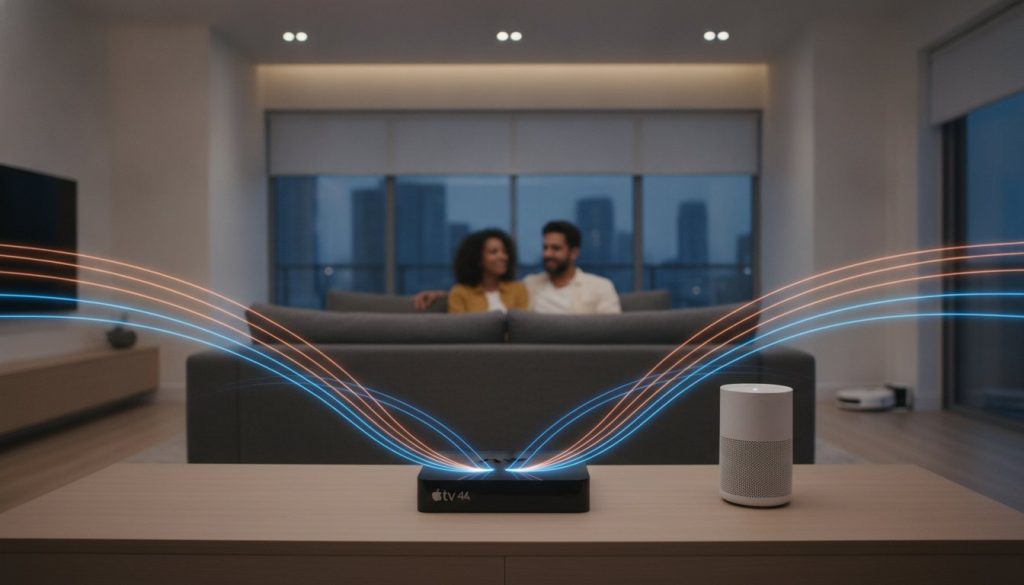
Buying the most expensive Apple TV 4K right now might actually be the worst move you can make for your smart home. With prices for the 128GB model jumping to $249 in June 2026, the “obvious” choice has suddenly become a test of your patience. It’s completely normal to feel frustrated by connection drops or confused by the technical jargon surrounding Thread 1.4 and Matter 2.0. You just want a home that responds instantly and stays connected while you’re away.
In this guide, you’ll discover how to select the best smart home hub for apple homekit without wasting money on hardware that might be obsolete by next year. We’ll show you how to navigate the recent price hikes and which bridges actually solve those “No Response” headaches. We are diving into the top-rated hubs for 2026, from the latest Aqara bridges to the upcoming Siri AI-ready devices, so you can build a stable, future-proof setup that makes your life easier.
Key Takeaways
- Understand why a dedicated, always-on device is now essential for your ecosystem and why the iPad has been officially retired from hub duties.
- Compare the Apple TV 4K and HomePod to identify the best smart home hub for apple homekit based on your specific connectivity and audio needs.
- Learn how to manage “bridge fatigue” by knowing exactly when specialized hubs like Lutron or Aqara are required for maximum reliability.
- Discover the hardware essentials, including Thread 1.4 support and A15 Bionic chips, that will make your setup ready for the 2026 Siri AI features.
- Follow our savvy selection steps to ensure your “brain” is perfectly positioned for a fast, responsive, and future-proof smart home.
What is a HomeKit Hub and Why Do You Need One in 2026?
Think of your smart home as a team of talented individuals. Your smart lights, locks, and sensors all have specific jobs, but they need a manager to stay synchronized. That’s where a HomeKit hub comes in. It serves as the local “brain” that keeps your devices talking to each other without needing to send every single command to a distant server. Finding the best smart home hub for apple homekit is the first step in moving from a collection of gadgets to a truly seamless living environment.
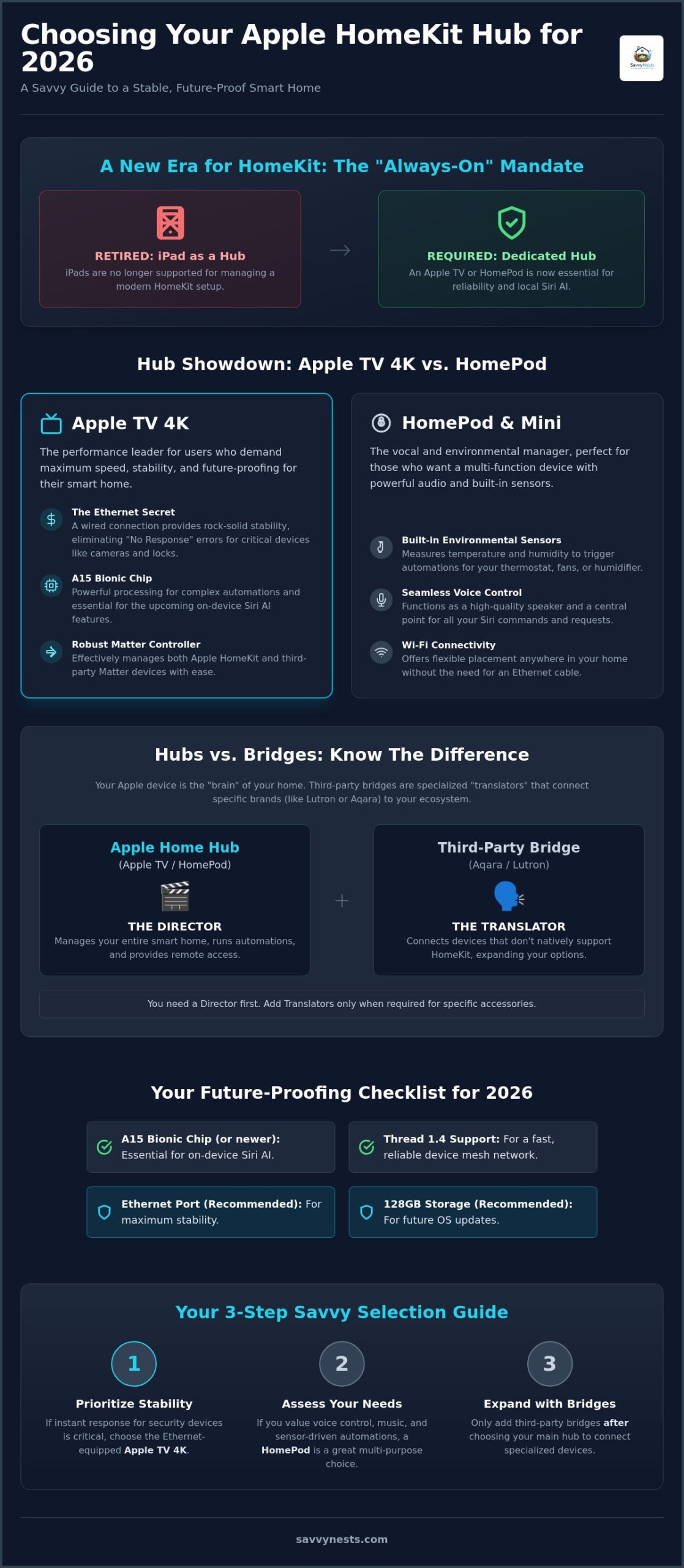
You might remember a time when an old iPad sitting on the kitchen counter could run your home. Those days are officially over. Apple now requires a dedicated, always-on device like an Apple TV or HomePod to manage the advanced architecture of modern smart homes. This change ensures that your automations run reliably even if your tablet leaves the house or runs out of battery.
To better understand how these devices fit into your daily life, watch this helpful video:
The “Always-On” Requirement
A reliable hub must stay plugged into power and your network 24/7. In 2026, this is more important than ever because your hub now processes Siri AI requests locally. This shift from cloud-based processing to local intelligence means your lights turn on faster and your private data stays inside your four walls. Your hub also acts as a secure gateway; it allows you to check your cameras or unlock the front door without exposing your network to the open internet. It’s the silent guardian that keeps your home responsive and safe.
Remote Access and Automation
One of the biggest perks of a hub is controlling your home from the office or while you’re on vacation. Without a hub, you can only control devices when you’re within Bluetooth or Wi-Fi range. With one, you can set “set-it-and-forget-it” routines that trigger based on your location or the time of day. For example, your lights can dim automatically when you start a movie. Understanding the Smart Home Hub vs. Smart Speaker distinction helps you decide if you need a screen, a speaker, or a hidden box in your media console. For a deep dive into the history of this technology, you can explore the evolution of Apple Home and HomeKit.
Finally, don’t confuse an Apple Home Hub with a third-party bridge. An Apple Home Hub, like an Apple TV, is the primary director of your home. A bridge, such as an Aqara or Lutron hub, is more like a translator for specific brands that don’t speak Apple’s language natively. While looking for the best smart home hub for apple homekit, remember that you need the Apple hub first. The bridges come later to expand your horizons and connect specialized equipment like high-end smart shades or specific security sensors. Before adding any new device to your setup, consulting a smart home hub compatibility guide can save you from the frustration of purchasing hardware that won’t work seamlessly with your existing ecosystem.
Apple TV 4K vs. HomePod: Comparing the Heavy Hitters
Choosing between an Apple TV and a HomePod is the most critical decision for your ecosystem in 2026. While both can act as the “brain” of your house, they serve very different roles. With the recent price shifts, where the Apple TV 4K now starts at $199 and the HomePod mini sits at $129, making a savvy choice is about more than just the price tag. You need to look at how each device handles the heavy lifting of your automations and device connectivity.
Apple TV 4K: The Pro Choice
If you want the absolute best smart home hub for apple homekit, the Apple TV 4K (3rd Gen or newer) is the performance leader. Its biggest advantage is the “Ethernet Secret.” By using a wired connection to your router, you effectively eliminate the dreaded “Updating…” status that often plagues Wi-Fi-only setups. This wired stability ensures that your cameras and locks respond instantly every time. The 128GB model is particularly future-proof, offering the extra storage and processing power needed for the advanced data requirements of iOS 27. It also serves as a robust Matter controller, allowing you to manage non-Apple devices with ease.
HomePod and HomePod Mini: The Vocal Choice
The HomePod (2nd Gen) and HomePod mini offer a different kind of value that goes beyond audio. These devices are environmental managers. They feature built-in temperature and humidity sensors that can trigger your smart thermostat or fans automatically. For example, you can set a rule to turn the AC on the moment your living room hits 78 degrees. They also include Sound Recognition, which can listen for smoke or carbon monoxide alarms and send an emergency notification to your iPhone. Understanding how smart hubs work to keep your data secure is vital when you’re placing microphones and sensors in your private living spaces.
Thread support is the non-negotiable feature for any best smart home hub for apple homekit contender. Both the HomePod mini and the higher-end Apple TV 4K act as Thread Border Routers. This technology creates a self-healing mesh network, meaning if one device goes offline, the others find a new path to stay connected. If you have a large home with dead zones, scattering a few HomePod minis in different rooms is an excellent way to expand your Thread coverage and keep your home responsive. If you’re still feeling stuck on which path to take, our team can help you find the right fit for your home. Whether you prioritize the wired speed of the Apple TV or the sensory intelligence of the HomePod, your choice will define how smoothly your home runs for years to come.
Do You Still Need Third-Party Bridges Like Aqara or Lutron?
Look at the back of your router. If you see a growing stack of plastic boxes and a tangled mess of Ethernet cables, you are likely experiencing “Bridge Fatigue.” It is a common frustration for anyone building a high-end ecosystem. While searching for the best smart home hub for apple homekit, you will surely encounter brands like Lutron, Aqara, and Philips Hue that insist on having their own dedicated gateway. It feels redundant, but these bridges often serve a vital purpose that your primary Apple hub cannot handle alone.
The landscape is shifting thanks to the Matter 2.0 standard. As of 2026, approximately 25% of all new smart home device shipments are Matter-certified. This means more devices can talk directly to your Apple TV or HomePod without needing a translator. However, this transition is not happening overnight. Many of the most reliable devices on the market still rely on specialized protocols to ensure they never miss a command or lose connection during a software update.
The Matter Revolution
Matter aims to simplify your setup by creating a universal language for your gadgets. When a device is Matter-ready, it can often bypass the need for a third-party bridge entirely. This reduces clutter and lowers your initial setup costs. But remember, not all Matter devices are created equal. Some work “Direct to Apple” over Thread, while others still benefit from a manufacturer’s bridge for advanced features like firmware updates or custom lighting scenes. To see how these different signals compete in the real world, check out our comparison of Zigbee vs Z-Wave vs WiFi Smart Home technology.
When a Bridge is Non-Negotiable
There are two main reasons to keep a bridge in your cabinet: reliability and specialized hardware. Lutron Caseta remains the gold standard for lighting because it uses a proprietary frequency that doesn’t interfere with your Wi-Fi. By offloading dozens of switches to a bridge, you ensure your lights work even if your router is struggling under the weight of multiple streaming devices. Additionally, brands like Aqara offer unique sensors for water leaks or vibration that Apple simply doesn’t make. These devices often use Zigbee, which requires a bridge like the $120 Aqara M3 to communicate with HomeKit.
When expanding your network, always weigh the IoT security considerations of each new gateway you add. The savvy move is to pick one best smart home hub for apple homekit as your primary controller and only add bridges that offer undeniable performance gains. This balanced approach keeps your home responsive, secure, and easy to manage without turning your utility closet into a server room.
Savvy Selection: How to Choose Your Perfect Hub
Choosing the best smart home hub for apple homekit isn’t just about picking the most expensive box on the shelf. It’s about matching the hardware to the physical layout of your home and your specific daily habits. To make a choice you won’t regret in six months, you need to look at your network through a “savvy” lens. Use the following four steps to narrow down your options based on performance and practicality.
- Step 1: Check your router location. If your router is tucked away in a basement or a metal cabinet, running a long Ethernet cable to your hub is the single best thing you can do for stability.
- Step 2: Count your Thread devices. If you’re buying new Nanoleaf bulbs or Eve sensors, you absolutely need a hub that acts as a Thread Border Router to keep those devices responsive.
- Step 3: Evaluate your audio needs. Do you want to walk into a room and shout “Hey Siri” to turn on the kettle, or are you happy using your iPhone or a remote?
- Step 4: Plan for expansion. If you intend to add smart appliances or non-Apple gadgets later this year, ensure your hub is ready to act as a Matter controller.
The “Ethernet First” Rule
We always recommend the Apple TV 4K (Ethernet model) as the primary hub for any serious setup. While Wi-Fi has improved, a hardwired connection provides the low-latency backbone required for high-definition security camera streams and complex automations. Your hub should be placed centrally relative to your Thread devices. Since Thread creates a mesh, your hub doesn’t need to reach every bulb, but it needs a strong “handshake” with the closest ones. If you live in a multi-platform house, you might also want to read our Best Smart Home Hub for Alexa and Google guide to see how other systems handle wired connectivity.
Budget vs. Performance
In a small studio apartment, a single HomePod mini is often “good enough” to serve as your brain. It covers a small footprint effectively and provides a Thread Border Router at a lower entry price. However, be careful of “Bridge Creep.” If you save money on a cheaper hub but then have to buy three separate $50 bridges for your lights, locks, and blinds, you’ve actually spent more than the cost of a high-end Apple TV. For the best value, look for refurbished Apple TV 4K units from 2024 or 2025; they often have the same A15 Bionic chip found in newer models but at a much friendlier price point. Before finalizing your purchase decisions, reviewing a thorough smart home hub compatibility guide will help you verify that every device you plan to buy will work together without requiring additional bridges or workarounds. If you’re still unsure which combination fits your specific floor plan, you can get personalized advice for your floor plan from our team of experts.
Setting Up for Success: Future-Proofing for Siri AI
The landscape of the smart home changed forever with the announcement of “Siri AI” at WWDC 2026. Powered by Apple Intelligence, your home is no longer just a collection of remote-controlled switches; it’s becoming a context-aware assistant. To take full advantage of this, your choice of the best smart home hub for apple homekit must prioritize processing power. With iOS 27 introducing AI-generated camera summaries and multi-step voice commands, the “brain” of your home needs more than just a connection to the internet. It needs the hardware to think locally.
Preparing for this rollout means looking closely at the silicon inside your devices. While older hubs might still handle basic light toggles, the new Siri AI features require an A15 Bionic chip or later to process personal context and on-screen awareness. This is why we’ve seen a shift in how these hubs are valued. A hub isn’t just a bridge anymore; it’s a local AI server that keeps your data private while making your home significantly more intuitive.
The Power of Local Processing
One of the biggest benefits of the 2026 ecosystem is that your AI requests don’t have to travel to a cloud server and back. Local processing is faster, more reliable, and far more private. This speed is essential when you’re asking Siri to perform complex tasks, like “Lock the front door and dim the lights if the kids are already in bed.” To ensure your hub has enough headroom for these iOS 27 automations, you should regularly check for firmware updates that enable Thread 1.4 support. This protocol improvement is vital for the increased data traffic that AI-driven homes generate. For maximum security, don’t forget to enable “Advanced Data Protection” in your iCloud settings to keep your home’s activity logs and camera feeds encrypted from end to end.
Your Smart Home Roadmap
If you’re just starting, don’t feel pressured to automate every room at once. The savvy approach is to begin with your primary hub and a single smart plug or light. This lets you test the responsiveness of your network before you scale up. As you grow, you can use our Smart Home Buying Guide to identify which Matter 2.0 devices will integrate most smoothly with your setup. Before you consider your installation complete, run through this final checklist:
- Is your hub running the latest version of iOS or audioOS?
- Have you placed your hub in a central, open location rather than a closed cabinet?
- Is your network secured with a strong, unique password and two-factor authentication?
By selecting the best smart home hub for apple homekit today, you’re building a foundation that will only get smarter. Whether you’re waiting for the rumored Fall 2026 Apple TV model or setting up a HomePod mini right now, you’re one step closer to a home that truly understands your needs.
Ready to Build Your AI-Ready Smart Home?
You now have the roadmap to transform your living space from a collection of apps into a unified, intelligent home. By prioritizing a hub with a wired Ethernet connection and ensuring your hardware is ready for the upcoming Siri AI rollout, you’ve already bypassed the most common pitfalls of modern home automation. Reliability isn’t just about speed. It’s about the peace of mind that comes from a system that works every time you walk through the door.
Selecting the best smart home hub for apple homekit is the most important investment you’ll make for your ecosystem this year. Whether you choose the raw performance of an Apple TV 4K or the sensory intelligence of a HomePod, your foundation is now secure. Our expert tested recommendations and no-jargon guides are designed to help you maintain this privacy and reliability as your needs evolve over the coming years.
Ready to take the next step? Build your savvy nest with our curated smart home picks! We are here to help you move from curiosity to confidence with a setup that truly serves your lifestyle. Your smarter, more convenient future starts with the right “brain” for your home.
Frequently Asked Questions
Can I use an iPad as a HomeKit hub in 2026?
No, you can’t use an iPad as a hub anymore. Apple officially retired this feature several years ago to ensure homes have a dedicated, always-on device that can handle the advanced processing of iOS 27 and Siri AI. You now need an Apple TV or a HomePod to keep your automations running reliably and securely.
Do I need a hub to use Apple HomeKit at home?
You don’t strictly need a hub for basic manual control when you’re standing in the same room as your devices. However, a hub is essential if you want to control your home while you’re at work or if you want to set up “set-it-and-forget-it” automations. It acts as the local brain that makes your home truly smart.
What is the difference between a HomeKit hub and a Matter controller?
A HomeKit hub is the primary director for your Apple-specific automations and secure remote access. A Matter controller is any device that can talk to gadgets using the Matter 2.0 standard. All modern Apple hubs now double as Matter controllers, which means they can manage a much wider variety of third-party brands than they could in the past.
Can I have more than one HomeKit hub in the same house?
Yes, and it’s actually a great idea to have multiple hubs throughout your home. Your Apple devices will automatically coordinate with each other, with one acting as the primary leader and others standing by as backups. This redundancy prevents your whole home from going offline if one device is accidentally unplugged or restarted.
Does the Apple TV 4K need to be on for HomeKit to work?
Your Apple TV doesn’t need to be showing a movie on your television, but it must stay plugged into a power outlet and connected to your network. It remains in a low-power “always-on” state in the background. This allows it to process commands and camera feeds even when your TV screen is turned off.
How do I know if my device is a Thread Border Router?
You can identify a Thread Border Router by checking the technical specifications for “Thread” support in the product description. For example, the 128GB Apple TV 4K and the $129 HomePod mini both include this technology. These devices are vital because they connect your low-power Thread sensors directly to your main home network.
Which Apple TV model is best for HomeKit?
The 128GB Wi-Fi + Ethernet model is the best smart home hub for apple homekit due to its wired stability and Thread support. While the 64GB model is $199, the extra $50 for the 128GB version ($249) is a savvy investment for the Ethernet port alone. A wired connection is much more reliable for high-bandwidth tasks like 4K HomeKit Secure Video recording.
Why are my HomeKit devices showing “No Response”?
This error usually happens when a device loses its connection to your hub or your Wi-Fi is experiencing heavy interference. If you see this often, try moving your hub to a more central location or switching to a wired Ethernet connection. Strengthening your Thread mesh with a few extra HomePod minis can also solve these frustrating connectivity headaches.

Article by
Michael J. Mahon
Smart home automation transforms ordinary homes into intelligent living spaces by connecting devices that improve convenience, security, energy efficiency, and comfort. SavvyNests makes smart home technology easy to understand with expert guides, reviews, and recommendations for every budget.