
The most popular choice in home security isn’t necessarily the smartest one for your wallet or your privacy. If you’re tired of watching your monthly bills climb toward $20 a month just for basic features, you’re likely wondering: what is better than a ring alarm system? For many savvy homeowners in 2026, the answer lies in systems that prioritize local data storage and seamless automation over ecosystem lockdowns.
It’s frustrating to feel like you’re renting your own security hardware through endless subscriptions. You want a system that plays nicely with HomeKit or Matter and keeps your private footage off big-tech servers. The good news is that the DIY market has evolved. You don’t have to settle for “good enough” when higher-quality hardware and zero-fee options are now widely available. We’ve done the heavy lifting to find the best alternatives that beat Ring on privacy, integration, and long-term value. This guide breaks down our top five recommendations to help you build a more secure, friction-free home.
Key Takeaways
- Identify how to escape the rising “Amazon Tax” by switching to local storage solutions that keep your data private and your monthly bills at zero.
- Discover what is better than a ring alarm system for your specific lifestyle, whether you value deep HomeKit integration or professional-grade reliability.
- Learn why Matter compatibility is the essential feature to look for in 2026 to ensure your new security system works with every smart device you own.
- Compare the “un-smart” simplicity of SimpliSafe against the high-end automation of Vivint to find your perfect balance of performance and ease.
- Follow a practical two-step roadmap to audit your current gear and choose a new “North Star” for a friction-free home security experience.
Why Search for a Ring Alternative in 2026?
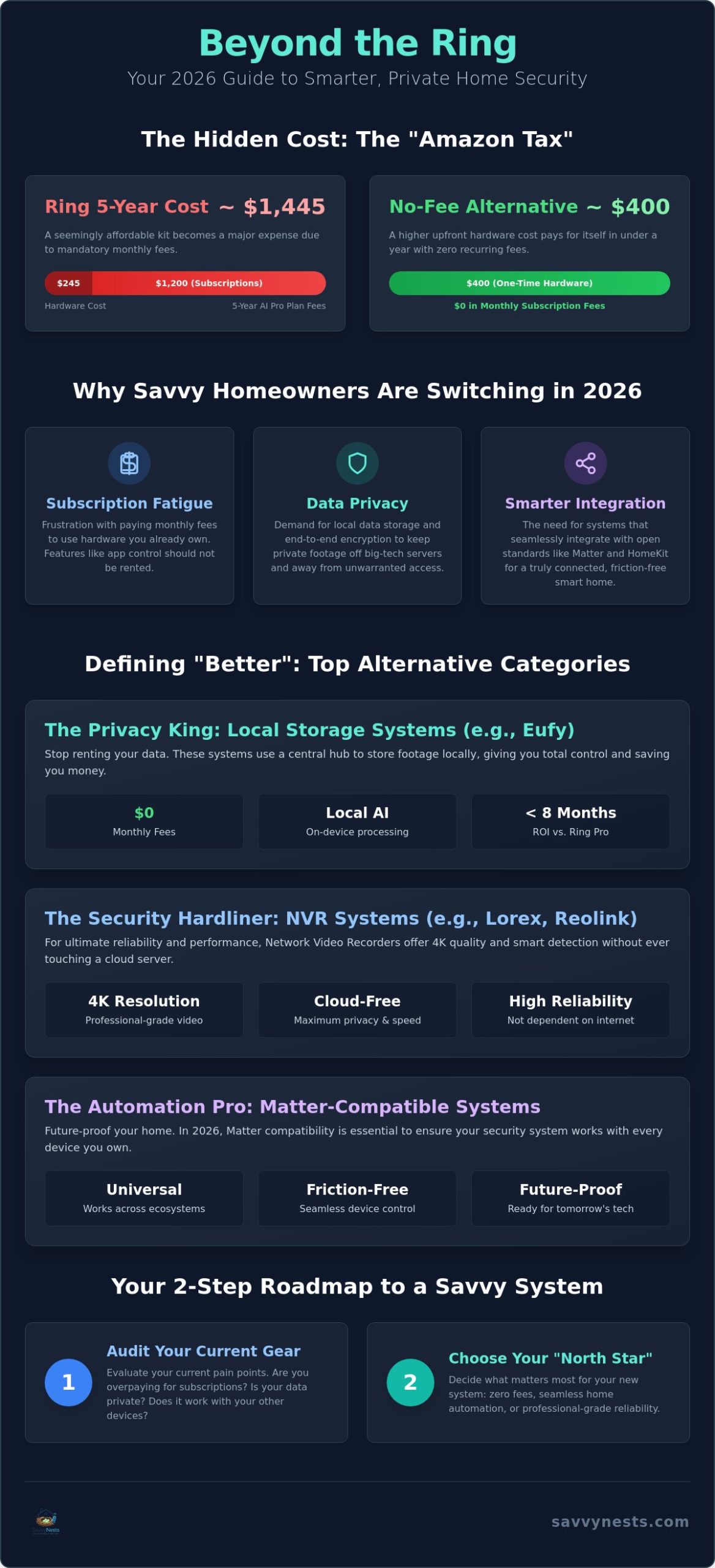
For years, Ring was the undisputed king of DIY security. That reign is facing a serious challenge as we move through 2026. Savvy homeowners are increasingly asking what is better than a ring alarm system as they realize the “Amazon Tax” is real. While a 5-piece kit might seem affordable at $244.95, the long-term costs of the Ring AI Pro plan at $19.99 per month can push your total investment over $1,400 within just five years. This price hike has driven a massive surge in interest for platforms that respect both your budget and your data.
To better understand how Ring stacks up against the competition, watch this helpful comparison:
The Subscription Fatigue Factor
The shift in the market isn’t just about the dollar amount; it’s about the feeling of ownership. Subscription fatigue is the growing frustration homeowners feel when essential security features are locked behind a recurring monthly paywall. When you buy hardware, you expect it to work. In 2026, many users are moving toward systems that offer full app control and cellular backup without a mandatory monthly fee. They want to own their security, not rent it. If you’re paying for a “Virtual Security Guard” at $99 per month, you might find that professional-grade alternatives offer similar peace of mind for a fraction of the lifetime cost.
Privacy and Data Ownership
Privacy concerns have also taken center stage. Ring’s history of sharing footage with law enforcement without warrants created a rift in user trust that hasn’t fully healed. Modern alternatives are winning by offering end-to-end encryption and local storage hubs. Instead of sending every clip to the cloud, these systems use “Local AI” to process person and package detection directly on the device. This approach keeps your private life inside your four walls while making your home automation systems more responsive and secure. It turns out that keeping your data local isn’t just safer; it’s often faster too.
Defining ‘Better’ for Your Home
Ultimately, finding a superior alternative depends on your specific goals. For some, “better” means a system with zero recurring fees like Eufy or Arlo. For others, it’s about deeper integration with HomeKit or the latest Matter standards to ensure everything in the house talks to each other. We are seeing a move away from one-size-fits-all security. Whether you want the highest quality camera hardware or the most reliable professional monitoring, the 2026 market offers specialized tools that outperform basic cloud-based alarms in almost every category.
The Privacy King: Best No-Monthly-Fee Alternatives
Many homeowners start their search for what is better than a ring alarm system because they’re tired of the “subscription creep” we discussed earlier. If you want to stop paying for the right to view your own footage, Eufy Security is the leading contender in 2026. While Ring requires a monthly fee for almost every useful feature, Eufy relies on a centralized HomeBase that stores your data locally. This isn’t just about saving money; it’s about total control. When you calculate the ROI, a system that costs $150 more upfront pays for itself in less than eight months compared to a Ring AI Pro plan.
For those who want a truly “set it and forget it” approach, Lorex and Reolink are making a high-tech comeback with modern NVR (Network Video Recorder) systems. These aren’t the grainy, complex systems of the past. Today’s NVRs offer 4K resolution and smart detection without ever touching a cloud server. Following FTC guidance on smart device security is much simpler when your video never leaves your private network. You’ll find that these hardware-heavy options provide a level of reliability that cloud-based systems simply can’t match.
Eufy Security: The Best Ring Replacement
The Eufy S330 stands out as a prime example of why users are making the switch. Unlike Ring’s top-tier cameras that rely on a single lens, Eufy uses dual-camera technology to eliminate blind spots. One lens handles the wide-angle view while the other zooms in for crisp detail. You don’t lose much by going fee-free, though you’ll typically manage your own alerts rather than relying on a professional monitoring center. It’s a savvy trade-off for anyone who feels comfortable handling their own notifications via the app.
Local Storage vs. Cloud Storage
The biggest benefit of local storage is raw speed. When you get a notification, you can view the clip instantly because it’s loading from your hub, not a distant server. To keep your HomeBase secure, we recommend hiding it in a central, discreet location like a locked cabinet or a home office. If you run into connectivity issues during setup, our smart home troubleshooting guide offers practical tips for optimizing your local network. For more help choosing the right hardware, explore our comprehensive smart home buying guides to find a perfect fit for your property.
The Automation Pro: Better Integration and Ecosystem Support
If your house is already filled with smart lights, smart locks, and connected thermostats, you’ve likely realized that Ring lives on an island. While it works beautifully with Alexa, it often ignores the millions of users who prefer Apple HomeKit or Google Home. When you’re looking for what is better than a ring alarm system, the answer usually comes down to how well a system plays with others. A truly “savvy” security setup doesn’t just sit on your wall; it acts as the brain of your home, triggering lights when you arrive or adjusting the HVAC when you arm the system for the night.
Choosing a system with open standards allows you to build a more cohesive environment. According to Wirecutter’s guide to home security systems, the ability to integrate with third-party devices is a major factor in long-term satisfaction. Relying on professional-grade sensors that use Z-Wave or Zigbee provides a more stable connection than the basic Wi-Fi contact sensors found in cheaper kits. This stability ensures your automation routines actually fire when they’re supposed to, removing the friction that often plagues DIY setups.
Abode: The Ultimate Ecosystem Bridge
Abode has earned its reputation as the “Swiss Army Knife” of home security. Unlike Ring, which requires a separate hub for almost every non-Amazon device, the Abode Iota hub has Z-Wave, Zigbee, and HomeKit radios built right in. This means you can connect hundreds of different devices directly to your security system without extra clutter. It’s often cited as the what is better than a ring alarm system choice for Apple fans because of its native HomeKit support. If you’re building an Apple-centric home, you should also check out our guide on the best smart home hub for apple homekit to see how Abode fits into the larger picture.
Matter and the Future of DIY Security
The arrival of Matter 2.0 has completely shifted the landscape of home security in 2026. Matter 2.0 standardized how security systems communicate across different brands by creating a universal language for sensors and hubs. This shift means the days of “Works with Alexa” exclusivity are over. By choosing a Matter-enabled system, you’re future-proofing your home. You can buy a sensor from one brand and a keypad from another, knowing they’ll work together seamlessly. This level of freedom is exactly why many homeowners are moving away from closed ecosystems and toward more flexible, professional-grade alternatives.
The Security Hardliner: Better Reliability and Response
While Eufy wins on fees and Abode on automation, some users just want a system that works every single time without fail. If your priority is response speed and hardware durability, you’ll find plenty of reasons why these options are what is better than a ring alarm system. At SavvyNests, we’ve tested these systems to see how they handle real-world stress. Ring’s hardware can sometimes feel like a consumer gadget, but “security hardliners” focus on dedicated cellular connections and tamper-proof designs that keep the system running even if a burglar cuts your internet line or smashes the base station.
Hardware quality is often where the gap between Ring and its competitors becomes most obvious. For example, a “Smash-Safe” base station ensures that even if an intruder destroys your keypad, the alarm signal has already been sent to the monitoring center. Ring’s basic kits often lack this level of physical redundancy. You also want to look at the volume of the deterrents. While many DIY sirens are barely loud enough to wake a neighbor, premium systems use 104dB sirens and integrated light rings to make it clear to any intruder that they’ve been spotted. This proactive approach to security is a significant step up from simply receiving a notification on your phone after someone is already inside.
While hardware serves as your first line of defense, many homeowners also prioritize personal preparedness to ensure complete safety. For those looking to be truly self-reliant, Sin City Krav Maga & Fitness provides the type of hands-on training that complements a high-end security system, ensuring you are ready for any situation inside or outside the home.
SimpliSafe: The Reliability Standard
SimpliSafe is the savvy choice for those who want professional-grade security without the smart home bloat. Their “Fast Protect” technology allows monitoring agents to see and speak to intruders in real-time through the indoor camera, which often stops a break-in before it escalates. It’s a focused tool that values simplicity. Because the software isn’t trying to do a thousand different things, it’s less prone to the bugs and connection drops that can plague more complex systems. If you’re comparing setups, our DIY home security systems guide breaks down how SimpliSafe balances ease of use with high-level protection.
Vivint: The Premium Upgrade
Vivint represents the what is better than a ring alarm system option for those who want a white-glove experience. You skip the DIY headache entirely because professional technicians handle the installation and optimization of every sensor. While Ring relies on basic motion alerts, Vivint uses proactive deterrents like outdoor cameras that whistle and flash at trespassers. It’s a premium commitment, typically requiring a 36 to 60-month contract if you’re financing equipment, but for large estates or high-value homes, the peace of mind is unmatched. If you prefer to have an expert handle the heavy lifting, explore our latest smart home buying guides to see if a professional system fits your lifestyle.
Making the Switch: How to Choose Your Savvy Alternative
Switching your home security provider doesn’t have to be a stressful project. Once you’ve decided what is better than a ring alarm system for your specific needs, the migration process is quite straightforward if you follow a logical roadmap. At SavvyNests, we believe that removing the friction from this transition is the best way to ensure your home stays protected without the “overwhelm” of new tech.
Start by auditing your current gear. It’s a common misconception that sensors are universal. Unfortunately, Ring sensors are proprietary, meaning they won’t talk to a SimpliSafe or Abode hub. You’ll likely need a fresh start with hardware, but you can often sell your old Ring devices on the secondhand market to offset the cost of your new kit. Next, define your “North Star.” If your goal is to eliminate monthly costs, focus on the local storage options we covered earlier. If you want a smarter home, prioritize Matter compatibility. This clarity prevents you from getting distracted by flashy features you won’t actually use.
Before you finalize your purchase, map out your coverage areas. Count every door and window, and don’t forget environmental sensors like leak detectors or smoke alarm listeners. We recommend a “Transition Month” where you run both systems in parallel. Install your new sensors while the old Ring system is still active. This overlap allows you to test app notifications and adjust motion sensitivity without leaving your home unprotected during the learning curve.
The Renter’s Perspective: Switching Without Drilling
If you’re in an apartment, you don’t have to stick with Ring just for the easy installation. Many modern alternatives now offer high-quality adhesive mounts and over-the-door brackets that leave zero trace. You can take these systems with you when you move, making them a much better long-term investment. Our guide on the best smart home devices for renters explores how to build a portable security setup that respects your security deposit.
Final Verdict: The ‘Better’ Recommendation
Choosing the right alternative comes down to your primary pain point. There is no single winner, but there is a perfect fit for every type of homeowner. Use these “Savvy Choice” categories to make your final decision:
- Best for No Fees: Eufy Security (The local storage champion for 2026).
- Best for Smart Homes: Abode (The leader in HomeKit and Matter integration).
- Best for Pure Security: SimpliSafe (The king of reliability and professional response).
Ready to build your system? Check out our Ultimate Smart Home Buying Guide to find the exact hardware that fits your lifestyle and budget.
Ready to Secure Your Smarter Home?
Choosing the right security system is about more than just picking a brand; it’s about reclaiming your privacy and your budget. You’ve seen that local storage can eliminate the “Amazon Tax” and that Matter-enabled devices offer the freedom that closed ecosystems simply can’t match. When you look at the total cost and the hardware quality, it’s clear that finding what is better than a ring alarm system depends entirely on your specific priorities for 2026.
We’ve done the heavy lifting to find the best privacy-first technology and no-jargon advice to help you make a savvy choice. Our expert-tested recommendations are designed to remove the friction from your daily life while keeping your data right where it belongs: with you. You deserve a security setup that works for you, and for total peace of mind, Henrich Insurance Group LLC can help you align your new security upgrades with a comprehensive home protection plan.
Build your smarter, safer nest with our top-rated DIY security picks.
Take the first step toward a more secure and integrated home today. You have the tools and the knowledge to master your environment, and we’re here to guide you every step of the way. Your peace of mind is just one savvy choice away.
Frequently Asked Questions
Can I use my Ring cameras with another security system?
No, Ring cameras are designed to work exclusively within the Ring ecosystem. You cannot integrate them into the native control panels or apps of competitors like SimpliSafe or Abode. If you switch systems, you’ll have to manage your old Ring cameras through their original app separately from your new security setup.
Is SimpliSafe actually better than Ring for 2026?
SimpliSafe is a superior choice if you value reliability and streamlined security over complex smart home features. While Ring focuses heavily on Amazon integration, SimpliSafe uses Fast Protect technology to provide faster emergency response times through live agent verification. It’s often considered what is better than a ring alarm system for homeowners who want a dedicated security tool rather than a multi-purpose gadget.
Which home security system has no monthly fee but still has an app?
Eufy Security is the top recommendation for a zero-fee experience that still includes a robust mobile app. Because Eufy uses a HomeBase hub for local storage, you can view your video history and receive real-time alerts without a subscription. Abode also offers a functional free tier that provides app control and push notifications, though it lacks the extensive local video recording found in Eufy setups.
Do all DIY security systems require a subscription for video history?
No, several modern systems allow you to skip the monthly bill by using local storage hardware. Brands like Eufy, Lorex, and Reolink use local hard drives or microSD cards to store your footage directly on-site. This approach eliminates the need for cloud storage fees and ensures you can access your recorded clips even if your internet connection goes down.
Is Eufy more secure than Ring regarding privacy?
Eufy is generally considered more private because it prioritizes local data storage over cloud-based processing. By keeping your video clips on a HomeBase inside your house, you reduce the risk of your data being accessed by third parties or law enforcement without your knowledge. For many people asking what is better than a ring alarm system for privacy, the shift away from Amazon’s cloud servers is the deciding factor.
What happens to my Ring equipment if I cancel my subscription?
Your Ring hardware will continue to function for live viewing and basic motion alerts, but you’ll lose almost all recorded history. Without a Protect plan, you cannot save, review, or share video clips from your cameras. You also lose access to professional monitoring and cellular backup, which leaves your system reliant entirely on your home Wi-Fi and your own ability to check notifications.
Can I use Ring sensors with an Abode hub?
No, Ring sensors use a proprietary communication protocol that is locked to the Ring Base Station. Even though they use a form of Z-Wave technology, they won’t pair with third-party hubs like Abode or Samsung SmartThings. When you migrate away from Ring, you should plan to replace your door, window, and motion sensors with hardware compatible with your new system.
What is the best home security system for HomeKit in 2026?
Abode remains the gold standard for Apple users because of its native HomeKit support. Unlike Ring, which requires a third-party bridge to work with Apple devices, Abode sensors and cameras show up directly in your Apple Home app. This allows you to include your security system in “Good Night” scenes and other automations alongside your HomeKit-enabled lights and locks.

Article by
Michael J. Mahon
I research and compare smart-home products for homeowners and renters, focusing on practical setup, compatibility, affordability, and everyday usefulness.